Relational transformation for humanitarian organisations and the people in them.
If humanity is our first principle, relationships must be our first practice.
About me
For over a decade I've worked in humanitarian and peacebuilding contexts — South Sudan, Iraq, Palestine, and others — long enough to learn that how an organisation performs and how its people fare are not separate questions. The same conditions that strain a programme strain the relationships inside it. The two move together, whether or not we choose to attend to them together.
Burnout, internal conflict, the slow saturation of trauma: these are rarely individual failures, though they're often carried as if they were. They live in how teams communicate, in how conflict moves through a group or gets stuck, in whether people feel held by the organisations they give themselves to, or quietly abandoned by them. Tending to them means changing not only what we do, but how we are with one another while we do it.
I work with organisations and the people inside them to build the capacity to stay with difficulty without coming apart — to tend to their own wellbeing with some durability, and through that, to the wellbeing of those they're there to support.
I know this terrain from the inside: the insecurity, the nearness to violence and loss, the operational overload that's become ordinary in our sector. That's a shared ground from which the real work becomes possible.
You might have found your way here because:
You're leading a team — in a humanitarian or development setting, a clinical service, or any frontline organisation — and watching it come under strain. Conflict surfaces more often. Good people leave, or stay and slowly disengage.
You hold a people-facing role — HR, wellbeing, staff care — asked to support colleagues across demanding contexts with limited resources and little in the way of a map.
You're responsible for the work itself — a programme, a service, a caseload — and you can see that unattended team dynamics are quietly eroding what you're able to achieve, while "we don't have time for that" has become the standing answer.
You're a practitioner — in aid, in medicine, in any of the helping professions — carrying the weight of what you've witnessed, finding it surface in your relationships at work or at home, and looking for support that understands the reality you work in rather than one abstracted from it.
Or you simply recognise that something needs to shift for you — a real change in how you, or the organisation around you, move through stress, conflict, and connection.
How we may work together
For Organisations and Teams
Build conflict-competent cultures
Where difficult conversations strengthen relationships rather than fracture them - building capacity through restorative dialogue, and trauma-informed conflict resolution.
Design feedback and accountability systems
That create psychological safety while maintaining high standards - because trust and performance are interdependent.
Establish trauma education as organisational practice
Moving beyond crisis response to build collective capacity for regulation, resilience, and relational repair.
For Individuals
Navigate stress, trauma, and transition
Via coaching and somatic therapy that restores capacity for choice, connection, and creative response.
Resolve interpersonal conflict
Through restorative mediation and conflict coaching that rebuilds trust and transforms relationships including with oneself.
I bring more than a decade of experience in designing and implementing community-based peace processes, reconciliation, leadership development and systems transformation.
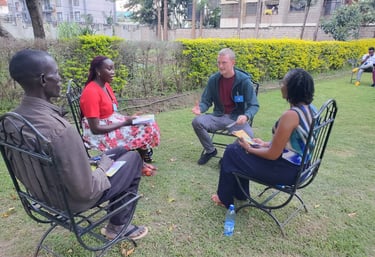
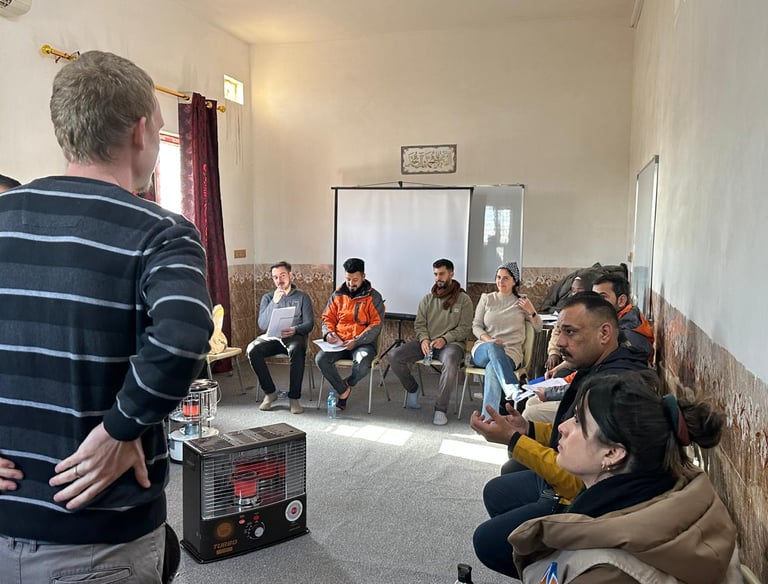
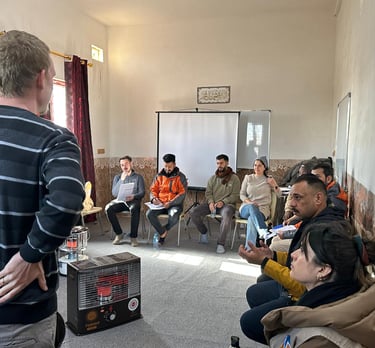
I've supported civil society organisations in conflict resolution, mentored practitioners in mediation and conflict transformation skills, and provided mental health and psycho-social support and trauma recovery coaching to humanitarian workers navigating high-stress contexts.
I've designed wellbeing systems for hundreds of staff, delivered 150+ trainings across multiple contexts, and authored training handbooks in trauma-informed peacebuilding.
My Approach Works With the Whole Person and the Whole System
My practice integrates:
Nonviolent Communication - the framework for needs-based dialogue and empathic connection
Somatic Experiencing and Soma Embodiment - working with the nervous system to process trauma and restore regulation
Restorative mediation (Chartered Institute of Arbitrators Associate, Mediate Your Life, Dominic Barter's restorative circles) - rebuilding trust and transforming conflict through NVC principles and practice.
Participatory theatre (Theatre of the Oppressed) - embodied exploration of power, conflict, and possibility.
Group Analysis - understanding the unconscious dynamics and relational matrices within groups, how individuals shape and are shaped by collective processes, and how transformation happens through group relationships rather than individual work alone.
These approaches work together because transformation is not just cognitive - it lives in our bodies, our relationships, and the systems we create together.
Organisations I've Worked With: Nonviolent Peaceforce | Norwegian Refugee Council | Danish Refugee Council | World Relief | Nonviolence International | Deutsche Gesellschaft für Internationale Zusammenarbeit (GIZ) | British Red Cross | International Alert
Experience That Understands Your Reality
Niklas has an extraordinary ability to foster a safe, inclusive and engaging environment, empowering participants to connect meaningfully and collaborate effectively.
Sunday N. (South Sudan - Protection Officer)
I felt such happiness and gratitude for this training opportunity with Niklas. The training didn't just teach us skills - it made us feel truly cared for and valued. We became part of something meaningful together.
Maryam A. (Sudan - Community Facilitator)
niklas@niklasvandoorne.org
+44 757 2121 948
© 2025. Niklas Van Doorne