Somatic Experiencing and Coaching
Most of us are carrying more than we let on. The pressures of work, the weight of difficult experiences, the patterns that keep repeating in our closest relationships — these leave traces, and they rarely resolve just because life moves on or we finally take a break.
I offer trauma-informed sessions informed by Somatic Experiencing and coaching that restores and expands your capacity to meet life as it is — so you can stay present in difficult moments, remain true to yourself inside them, and keep showing up for what and who matters to you, without it quietly costing you everything.
Some of the people I work with hold tremendous complexity for a living. Others are simply moving through a hard season — stress that won’t lift, a loss that hasn’t settled, anxiety, a relationship under strain, or the sense of going through the motions in a life that you would like to feel fuller. Wherever you are coming from, the aim is the same: more room to breathe, and a wider, steadier ground from which to make your choices.
You may be carrying more than you realise
Difficult experiences leave traces in the body — whether they come from years in a demanding role, a single overwhelming event, or the slow accumulation of ordinary stress. They don’t simply resolve when circumstances change, or even when you’ve finally taken a long break.
Sometimes it shows up as persistent stress and exhaustion, or the loss of motivation that once carried you. It can look like a shorter fuse than you used to have, difficulty remembering things that used to come easily, or trouble being fully present with the people you love — a sense of functioning, but only going through the motions. For some it is sharper: intrusive memories, restlessness, the hum of a hypervigilance that won’t switch off.
Maybe trust has become harder — in the people around you, in your workplace, in your environment. Maybe you notice yourself, or others, growing more reactive and irritable, and silence settling in the places where an honest conversation would have helped.
This work is for the moment you are ready to stop carrying it alone. We don’t need to talk about it endlessly. By working with the body, we build a deeper layer of resilience — a steadier capacity to regulate yourself in the situations that have always asked a great deal of you.
Who I work with
I work with people from many walks of life. I bring particular resonance to those in demanding, high-stakes fields:
• Humanitarians, aid workers, and peacebuilders
• Activists and organisers
• Social-impact leaders and founders
• Caring professionals — educators, social workers, responders
• Mediators and facilitators
• Security and public-safety professionals
And I work just as readily with anyone navigating the difficult business of being human — stress and burnout, anxiety, low mood, grief and loss, life transitions, strain in relationships and family, or simply the patterns you would like to understand and change. If you are carrying something you would rather not carry alone, this work is for you.
What we work on
People come to me with a wide range of things. Often it is stress that won’t switch off, burnout and the cycles that keep regenerating it, or anxiety and a nervous system that stays on alert. Sometimes it is grief and loss, a difficult life transition, or low mood and a harsh inner critic. Often it is conflict and strain in relationships — at home or at work — and the patterns that keep repeating no matter how clearly you see them.
For those in demanding roles, the work often also touches moral injury and the slow accumulation of exposure, secondary trauma and compassion fatigue, the empathic strain of holding other people’s conflict, decision fatigue and the particular isolation of responsibility, and the values conflicts that surface when what you are asked to do sits at odds with who you are.
Wherever you begin, we work toward steadying your baseline and downshifting from hypervigilance or freeze; restoring sleep, energy, and rhythm; repairing boundaries without guilt; processing what is still held from the past, building capacity for embodying emotions; untangling the patterns that keep repeating; rebuilding trust and connection; and making decisions you can actually live with — aligned with what matters to you, and sustainable.
How I work
I bring more than a decade of work in some of the world’s most demanding environments — as a programme manager and senior advisor on peacebuilding projects for international organisations in South Sudan, Iraq, and the Philippines, and in training civil-society and NGO staff in protection, dialogue, and trauma-informed practice. That history gives me a particular feel for high-pressure, high-stakes contexts. But the body, the nervous system, and the patterns we carry from our earliest relationships are human before they are professional where we often put up our brave faces — and the work I do rests on approaches that serve anyone, whatever they are facing, and where you can find acceptance of who you are.
My practice draws on three closely related traditions.
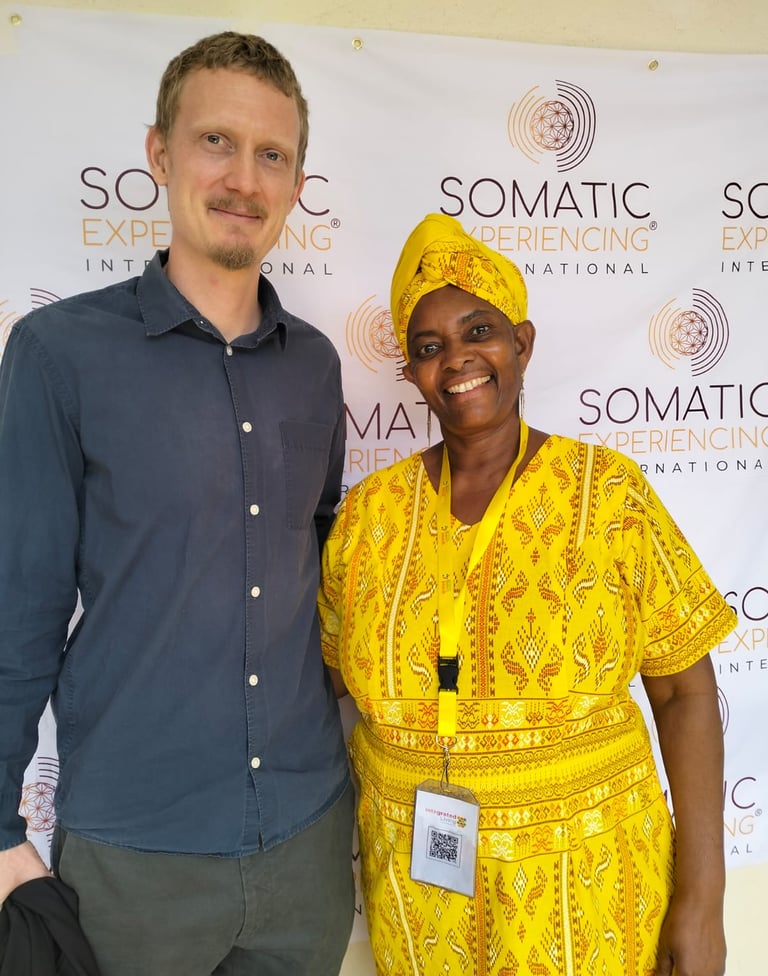
It draws primarily on Somatic Experiencing of which I am a current student — a body-based approach to trauma and stress that works with your nervous system’s own capacity to regulate, a capacity that chronic stress and survival responses tend to inhibit over time. This goes beneath the narrative and the thoughts you carry about what happened. We track the body’s signals — breath, posture, sensation, activation — and work through titration and pendulation, small and paced, rather than overwhelming dives into the hardest material. There is no need to return to traumatic memory: trauma is held more in the body than in the story, and it is in the felt sense that it can finally settle. For people willing to engage and expand their interoceptive awareness, this is often remarkably effective.
It draws on group-analytic thinking to make sense of how we are shaped by our relational worlds. We are formed by the groups we belong to — families, teams, communities, organisations — and by the roles we have taken up, or had handed to us, within them. Those roles do not stay behind; they continue to shape how you relate and what you carry. This lens also takes seriously how power and belonging live not only in a structure or an org chart but in the body and in the life of a group — which matters whether you are making sense of a family, a workplace, or the wider forces that have shaped your life.
And it draws on Nonviolent Communication as a needs-based language and a repertoire for building self-empathy, and empathy for others, under pressure — a way of turning judgement and limiting beliefs into curiosity. My work is also parts-informed: it recognises the multiplicity within each of us and the internal conflicts you may know well, and it moves toward integration, beyond a world of either/or.
A few things hold true of how we work together. It is somatic and paced — we create safety and choice by working with your body’s signals, not by forcing the material. It is relational and practical: grounded conversation, small skills and exercises during sessions, and practices that travel into daily life. It is systems-aware, because I account for the realities you are embedded in — relationships, work, culture, the pressures of your situation — and design change to hold up in real life, not only in the ideal version we build in our heads and then watch never arrive.
A note for those who face critical incidents
Some of the people I work with operate in insecure places, where the work carries a particular load: split-second decisions, constant alertness, exposure to harm, organisational and public scrutiny. With people in these roles, the work is to down-shift without losing your edge; to metabolise critical incidents and cumulative stress; to navigate values dilemmas and moral injury; to restore sleep, boundaries, and connection at home and on the team; and to build a repeatable practice of regulation you can draw on, on duty and off.
Ways to work together
Foundations — 6 Sessions
6–10 weeks
We build a personal regulation practice and begin shifting from automatic reaction to conscious choice. You'll leave with concrete tools—what actually works for you when you're activated, when you're depleted, when you need to be present and can't find your ground.
This includes session summaries, tailored practices for different contexts (including high-pressure work environments), and optional between-session check-ins.
This is often right for: beginning trauma integration, burnout recovery, boundary work, stabilising sleep and energy, or simply wanting a foundation before going deeper.
I recognise that the people who most need this support may not always have the financial means. If cost is a barrier, please reach out—we can usually find a way.
Deepening — 12 Sessions
3–4 months
For patterns that have been running a long time. We work with what's chronic—the stress that's accumulated over years, the relational dynamics that keep repeating, the places where you know something needs to shift but insight alone hasn't changed it.
This integrates somatic processing, values clarification, conflict skills, and practices for repair—at work and at home.
This is often right for: cumulative stress and moral injury, repeated conflicts with colleagues or partners, longer-term resilience building, and working through experiences that are still held in the body.
Leadership & Responsibility — 20 Sessions
6 months
For people who hold responsibility for others—team leads, programme managers, country directors, founders, coordinators. Leadership in high-stakes contexts requires a regulated nervous system, not just good intentions. When you're dysregulated, it ripples outward. When you're grounded, that ripples too.
This track combines personal trauma and stress work with the relational demands of leadership: holding difficult conversations, staying present when others are activated, making decisions under pressure without losing yourself.
This is often right for: people managing teams in demanding environments, those navigating the loneliness of senior roles, leaders who want to show up differently but find themselves reverting to old patterns under stress.
Individual Sessions
If you're not ready to commit to a package, or you prefer flexibility—booking as needed, around unpredictable schedules—individual sessions are available.
If one of these speaks to you, please reach out.
niklas@niklasvandoorne.org
+44 757 2121 948
© 2025. Niklas Van Doorne